Top iridology camera, iriscope Suppliers and Manufacturer

Understanding an emotional blueprint in iridology

The Concept of an emotional blueprint in iridology
The concept of mapping emotional patterns to ocular anatomy originated largely through behavioural iridology models, such as the Rayid method developed in the late twentieth century. In this philosophy, the eye reflects psychological predispositions alongside constitutional physical vitality. Specific iris patterns, such as flower-like openings, tightly packed jewel-like pigments, or stream-like radial lines, are categorised into distinct behavioural types reflecting analytical, creative, kinesthetic, or sensitive temperaments.
Practitioners of traditional Iridology view concentric contraction furrows, often termed nerve rings or stress rings, as indicators of emotional tension held within the neuromuscular system. When these rings appear prominent, the practitioner may explore whether the individual tends to absorb external pressures, leading to internalised restlessness or fatigue. Similarly, variations in pupil size, shape, and boundary tone are considered in relation to autonomic nervous balance, reflecting shifts between sympathetic alertness and parasympathetic recovery.
Iris interpretation represents a subjective educational model designed to prompt holistic self-awareness. It does not measure neurochemical levels, psychological conditions, or medical pathologies, and must never replace clinical mental healthcare.
Exploring these patterns provides holistic consultants with an engaging visual anchor during constitutional wellness evaluations. By reviewing these configurations, clients often reflect on stress triggers, work-life balance, and interpersonal communication styles. The resulting observations provide a framework for personalised lifestyle adjustments, gentle mindfulness practices, and targeted nutritional support within natural therapy practices.

Macro iris photography allows practitioners and clients to review constitutional patterns together in an educational environment.
Distinguishing Interpretive Models from Clinical Healthcare
Maintaining a clear distinction between educational iris analysis and clinical assessment protects client welfare. While traditional iris interpretation offers valuable metaphorical insight into behavioural tendencies, scientific research has not validated iris tissue as an accurate indicator of mental health disorders, psychological trauma, or systemic diseases. Clear communication prevents misconceptions regarding what an iris examination can and cannot accomplish.
Consulting an educational Iridology Chart allows practitioners to show structural zones correlated with specific body systems and constitutional reflex points. However, any finding shared during a session remains an interpretive cue rather than a definitive medical statement. Clients experiencing persistent anxiety, low mood, or physical symptoms should always consult a registered general practitioner or credentialed mental health professional for formal diagnostic investigation.
Educational Iris Analysis
- Explores lifestyle balance and tension
- Identifies general constitutional tendencies
- Encourages proactive self-care dialogue
- Uses visual charts as educational references
Conventional Medical Assessment
- Diagnoses clinical psychiatric conditions
- Employs validated diagnostic testing protocols
- Formulates targeted therapeutic interventions
- Conducted by registered medical professionals
Ethical practitioners routinely outline these parameters before beginning an assessment. When evaluating an interpretation, clients should verify that the practitioner operates within an educational scope, avoids definitive claims of pathology, and respects client privacy. Professional boundaries ensure that holistic observations serve as supportive guidance rather than unauthorised medical conclusions.
Digital Visual Documentation and Record-Keeping Systems
Modern natural therapy clinics frequently use advanced digital optics rather than traditional handheld magnifying glasses to observe iris topography. Incorporating a dedicated iridology camera creates consistent lighting, true colour fidelity, and magnification necessary to examine intricate iris trabeculae. Stable digital imaging enables detailed client consultation while creating an objective historical record for longitudinal wellness tracking.
Visual clarity helps clients actively participate in consultations, viewing structural features such as crypts, radii solaris, and pigmentation zones directly on screen. High-resolution imagery supports meaningful lifestyle discussions, allowing practitioners to explain constitutional theory clearly. Comparative imaging across successive visits assists in documenting long-term client compliance with recommended wellness routines.
| Tool Type | Primary Purpose | Operational Benefits |
| Handheld Magnifier | Initial screening | Portable optical inspection for brief visual checks during initial consultation. |
| Digital Iriscope | Image capture | Delivers stable lighting and high-resolution capture for accurate record maintenance. |
| Analysis Software | Documentation | Stores historical records and generates visual client education summaries. |
| Reference Chart | Educational guide | Provides structural zone overlays for informative client consultations. |
Optical consistency remains vital when comparing iris images captured months apart. Professional digital systems utilise calibrated LED illumination around the lens to minimise glare and shadow distortion, delivering reproducible images that support reliable documentation. Clear records promote professional accountability and enhance educational engagement in multidisciplinary wellness environments.
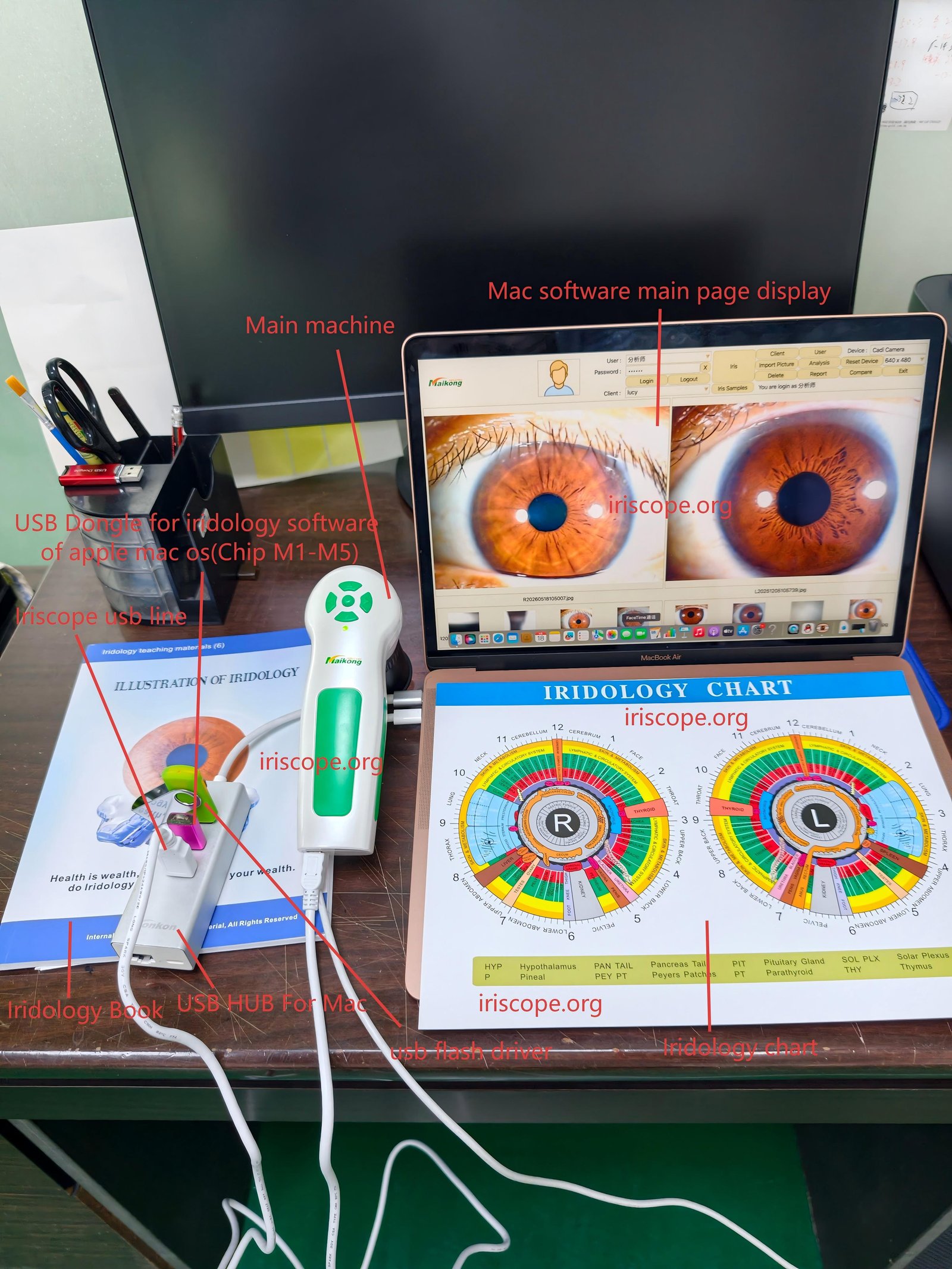
Dedicated iris imaging devices deliver balanced illumination and magnification for consistent documentation.
Equipment Specifications and Software Compatibility
Selecting reliable iris imaging equipment requires careful consideration of sensor specifications, ergonomic handling, and cross-platform software performance. Contemporary systems, including the MAIKONG iriscope line, feature high-resolution CCD sensors and specialised digital signal processors with optical image stabilisation. Single-touch capture buttons and adjustable manual focus rings allow practitioners to record sharp images without client discomfort.
Practice workflow depends heavily on software compatibility across diverse clinic computer environments. Dedicated Iridology Software designed for modern operations should integrate client record databases, multi-language support, and structured reporting tools. Compatibility across both Windows and Apple operating environments allows flexible clinic deployment without expensive workstation overhauls.
Windows Operating Systems
Software supports Windows 2000, XP, Vista, 7, 8, 10, and 11 across both 32-bit and 64-bit systems. Comprehensive compatibility facilitates integration with existing desktop computers in established practices.
Apple macOS Environments
Support covers macOS versions including Mojave, Catalina, Big Sur, Monterey, Ventura, Sonoma, and Sequoia. Dedicated driver architecture allows Mac-based wellness clinics to capture and catalogue images smoothly.
Standard iridology hardware carries an expected design service life of five to ten years when properly maintained. Factory warranties typically provide twelve months of coverage for non-human-caused technical malfunctions, supported by direct factory service facilities. High manufacturing standards aligned with ISO9000 quality management systems help maintain long-term reliability for demanding clinical and educational environments.
Frequently Asked Questions
What is an emotional blueprint in iridology?
An emotional blueprint in iridology is an interpretive holistic model that correlates iris structures, markings, and pigment distribution with behavioural tendencies and stress responses. It serves as an educational framework for personal lifestyle discussion rather than a clinical diagnostic method.
Can iris markings diagnose anxiety or mental health conditions?
No, iris markings cannot diagnose, treat, or confirm anxiety, depression, or any other mental health condition. Visual patterns such as contraction furrows only indicate generalised constitutional tension, and clinical concerns require evaluation by a qualified medical professional.
How does a practitioner reference an iridology chart during a session?
Practitioners use an iridology chart as a visual educational guide to demonstrate traditional structural reflex zones corresponding to various body systems. The chart assists in explaining constitutional tendencies to clients in a clear, accessible manner.
What computer systems support MAIKONG iridology software?
MAIKONG iridology software operates on Windows 2000, XP, Vista, 7, 8, 10, and 11 in 32-bit and 64-bit formats, as well as Apple macOS systems from version 10.14 through version 15. The software does not currently support Linux, Android, or Unix operating platforms.
Summary and Professional Next Steps
Exploring an emotional blueprint within iridology offers natural therapy practitioners an engaging, non-invasive method for discussing stress management, constitutional vitality, and holistic self-care. Maintaining strict ethical boundaries between educational interpretation and clinical medicine protects client wellbeing while establishing trust. High-quality digital optical systems and robust documentation software empower practitioners to communicate visual observations clearly and professionally.
Equip Your Practice or Become an Australian Distributor
Incorporate high-resolution iris imaging systems into your clinic, training academy, or wellness distribution network. Enquire today for product specifications, wholesale opportunities, and regional partnership details.
Contact US Online WHATSAPP: